How to Read the Huntsville Utilities Water Quality Report
Huntsville Utilities’ water quality report can look like a wall of chemical names, abbreviations, and numbers. The key is knowing which water system and monitoring period the report covers, how to read its standards and results, and what those results can—and cannot—tell you about water at your own tap.
Start With the Right Report and Reporting Period
Look for the water quality report on the official Huntsville Utilities website. It may be called a Consumer Confidence Report, or CCR. If the report is difficult to locate, Finding Your Annual Consumer Confidence Report in Alabama explains where Alabama customers can look for these reports.
Before interpreting any results, check three details near the beginning of the document:
- The water system or service area. Confirm the report applies to your address. A utility may serve customers across different areas, and a report may describe one system or more than one.
- The monitoring period. Find the year or date range represented by the data. A report’s publication date and the period covered by its test results are not necessarily the same.
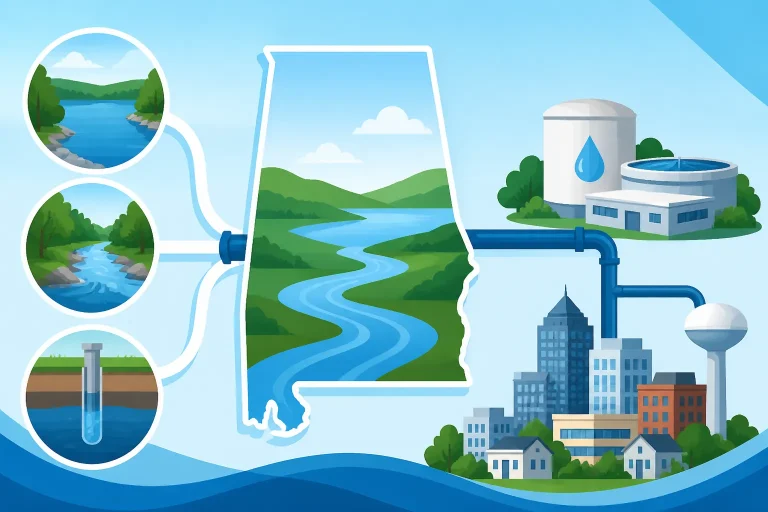
- The source and treatment description. The report may describe where the system’s water comes from and how it is treated. This gives useful context, but it is not a substitute for the results table.
If your address is near a service-area boundary or you are uncertain which system supplies your home, ask Huntsville Utilities to confirm it. Do not assume that a report applies just because it is the closest one online or mentions Huntsville.
The report is a summary of monitoring and regulatory information for a public water system. Its results generally describe water sampled at specified points in the system, not a separate test of every home. That distinction matters when a concern may come from plumbing within a building. Alabama Tap Water Quality: Finding Public Utility Data offers more background on checking public utility information.
Find the key sections
Reports are organized differently, so headings and table layouts may vary. Look for sections titled something like:
- Water source or sources
- How the water is treated
- Water quality data or detected contaminants
- Definitions of terms and units
- Lead and copper information
- Violations or other compliance information
- Contact details and public participation information
Start with the report’s definitions before comparing numbers. A term such as “range,” “highest level detected,” or “MCL” has a particular meaning, and the report should explain how it is being used.
If a result is absent from a table, that does not automatically tell you why. It may not have been part of that table’s reporting period, or the system may present it in another section. Review the notes and ask the utility about a result or category that is unclear.
Read the Results Table by Column
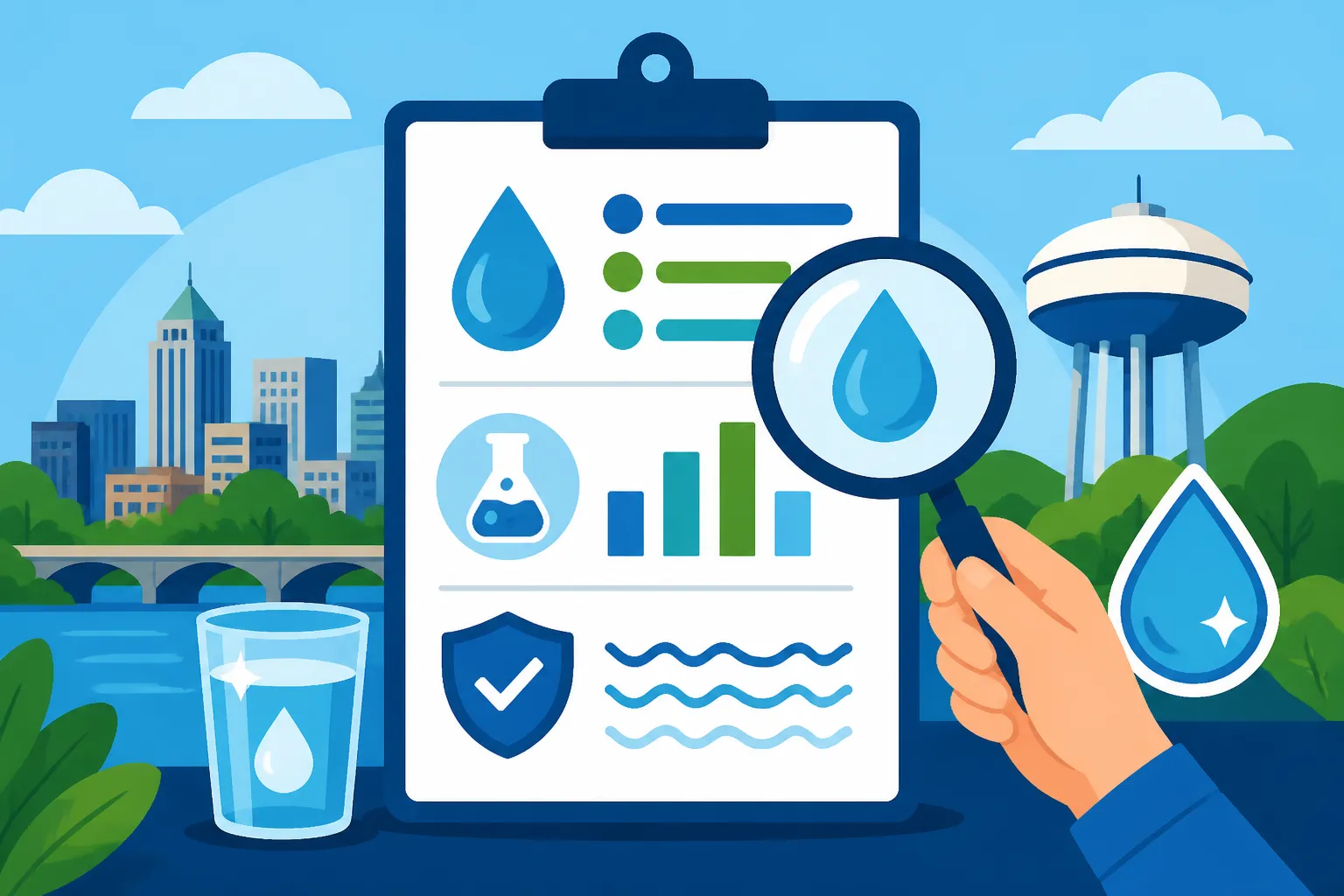
The results table is usually the most information-dense part of the report. Read it one row at a time, and use the column headings to understand what each number represents. A result has little meaning on its own: the contaminant name, unit, sampling method, reporting period, and applicable standard all matter.
| Table item | What it generally tells you | What to check |
|---|---|---|
| Contaminant | The substance or measurement being reported | Whether the name includes a specific form or group |
| Unit | How the result is measured | Whether it is ppm, ppb, or another unit |
| MCL or other standard | The regulatory limit or compliance measure used for that item | The report’s definitions and any footnotes |
| MCLG or goal | A non-enforceable health goal, where applicable | How it differs from the regulatory limit |
| Result or level detected | The reported measurement or compliance calculation | Whether it is an average, percentile, maximum, or individual result |
| Range | The spread between reported low and high results, when provided | Which samples and time period the range covers |
| Violation or compliance status | Whether the system reports a regulatory violation | The explanation and period involved |
Identify what the result measures
A table may report a single result, a range, or a value calculated from multiple samples. A “highest level detected” is not the same thing as an average. A range gives the lowest and highest reported results within the period stated, but it does not necessarily show how often each value occurred.
Some results are calculated using a specific sampling rule rather than shown as a simple measurement. For example, lead and copper compliance uses results from sampled taps and a system-level calculation. A value in that section should not be read as a measurement from every household or as a prediction of the level at your faucet.
Read the notes below the table closely. They may explain whether a result is based on a running annual average, a sample percentile, a maximum, or another method. If the report uses a term that is not defined, ask the utility what the value represents before drawing conclusions.
Check the units before comparing numbers
Concentration units are easy to misread. Parts per million and parts per billion are different scales; a number in one unit cannot be compared directly with a number in another without conversion. Other entries may use units specific to the measurement or treatment process.
Compare the result with the standard in the same row and in the same units. Avoid comparing values from different reports unless the units, sample method, and reporting periods match. Understanding Drinking Water Contaminant Standards: MCL vs MCLG explains the difference between two common standards you may see in a report.
Understand Standards, Detection, and Compliance
Water quality reports often list a detected result beside one or more standards. The terms can sound similar, but they do not mean the same thing.
MCL and MCLG
An MCL, or Maximum Contaminant Level, is an enforceable regulatory limit for a contaminant in public drinking water. An MCLG, or Maximum Contaminant Level Goal, is a non-enforceable health goal. Some contaminants have an MCLG; others may not.
Do not treat these entries as interchangeable. A result can be below an MCL but above an MCLG, because the enforceable limit and the goal may differ. The report’s notes should explain how to interpret the specific row.
An MCL is a compliance standard for the regulated water system, not a guarantee that every tap in every building has the same measured concentration. Nor does a table entry by itself tell you what an individual’s health risk is. For questions about personal health effects, contact a medical professional or your local health department.
MRDL and MRDLG
For disinfectants, a report may use MRDL, or Maximum Residual Disinfectant Level, and MRDLG, or Maximum Residual Disinfectant Level Goal. These are distinct from MCL and MCLG. The report’s definitions explain which measure applies and how results are evaluated.
If you notice a disinfectant result, read the entire row and its notes rather than interpreting the number as a simple “more is better” or “less is better” measure. The relevant standard depends on the substance and regulatory method.
“Detected” does not automatically mean “violation”
A contaminant can be detected and still be below the applicable regulatory limit. Detection means the substance was measured at or above the reporting level used for that test. It does not, by itself, mean that the system violated a standard.
Likewise, a result below a reporting threshold does not always mean that none of the substance is present. It means the test did not report a measurable result at that level under the method used. The report may use terms such as “not detected,” “below the detection limit,” or “less than” a stated value. Check the definitions and footnotes to see what the wording means for that test.
A result also needs its correct unit and standard to be meaningful. For example, a small-looking number cannot be judged as acceptable or unacceptable without knowing what was measured and how that contaminant is regulated.
Read compliance language directly
Look for the report’s statement about violations or noncompliance. If it identifies a violation, read the explanation: it may specify the contaminant, time period, reason, and corrective steps or notices. A violation is a regulatory finding; the report’s description is the right place to learn what happened and whether it was resolved.
If no violation is listed, that is useful information about the system’s reported compliance status for the period covered. It does not establish that every possible contaminant was tested, or that every home’s plumbing was sampled. For broader background on how utility results relate to a household tap, see Can an Alabama Utility Water Report Predict Your Tap Quality?.
Pay Special Attention to Lead and Copper
Lead and copper are often reported in a separate section because they are evaluated differently from many other contaminants. The report may describe the number of sampled taps, the sample results, and a system-level statistic such as a percentile. That statistic is not an average for every customer and is not a test result for your own home.
A regulatory action level is used to determine whether a system must take specified actions under the applicable rule. It is not a line that tells you the exact concentration at every tap. Read the report’s explanation of the sampling method and the system’s next steps if an action level is exceeded.
Utility results do not test every home
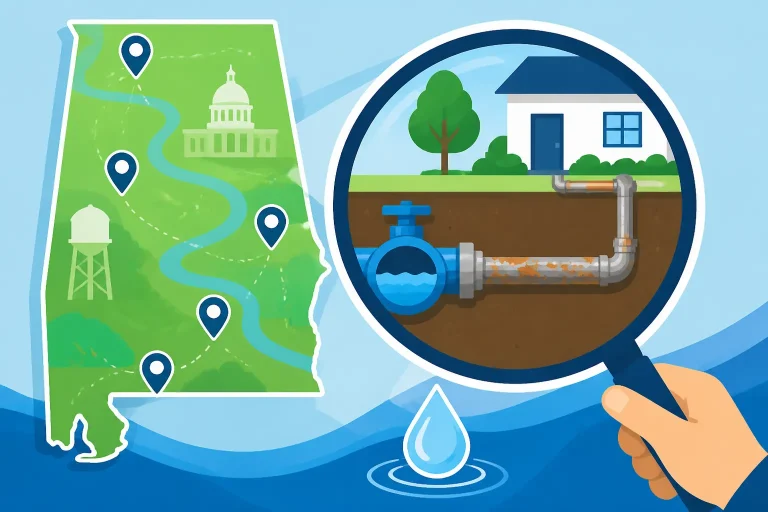
Lead can enter drinking water through plumbing materials or service lines, so water conditions can vary between buildings. The utility report cannot identify the materials in your home’s plumbing or determine your tap’s lead level.
If you have a concern about your home, review the report alongside information about your service line and plumbing. Lead and Copper in Alabama Tap Water: Testing and Rules explains the distinction between utility monitoring and household testing. For practical ways to check the pipe material, see Finding Out What Your Water Service Line Is Made Of.
A household test should be collected and analyzed using a method suited to the question. Follow the laboratory’s collection instructions, especially if the test is for lead. A sample collected at the wrong tap or in a way that does not match the testing protocol may not answer what you need to know.
If a report describes a lead-related exceedance or notice, follow the instructions in the notice and contact Huntsville Utilities for system-specific information. For concerns about possible exposure or health effects, ask a medical professional or local health department rather than relying on a report table alone.
Use the Report to Decide What to Ask Next
A report is most useful when you connect its results to a specific question. Rather than trying to interpret every entry at once, identify what prompted you to open the report: a general check, a taste or odor concern, a lead question, or a result mentioned in a notice.
If you are reviewing general water quality
Confirm the report’s service area and reporting period. Read the source and treatment overview, then scan the results table and any compliance summary. Note which contaminants were detected, how each result was calculated, and whether the report lists a violation.
A report’s scope is defined by required monitoring and the tests described in it. Do not assume that it covers every substance someone might ask about or that it is a test of a particular home. How to Read Central Alabama Water’s Annual Water Quality Results provides another example of how to work through a utility report’s sections.
If you are investigating a change at your tap
A utility report may help explain systemwide monitoring, but it may not explain a change limited to one faucet or one building. Notice whether the issue affects one tap, several taps, or multiple properties, and whether it changes after running cold water. These observations can help you explain the problem when you contact the utility or a plumbing professional.
A taste, smell, color, or pressure change does not identify its cause by itself. Contact Huntsville Utilities when you suspect a system issue or need help understanding local conditions. For persistent or unusual problems, Persistent Water Issues: Why ADEM Suggests Calling Your Utility First describes why contacting the supplier is a useful first step.
If you need information beyond the report
Ask specific questions so the utility can direct you to the right information:
- Does this report cover my address and water system?
- What sampling period does this result represent?
- Is the number an average, a maximum, a percentile, or another calculation?
- What does the table’s footnote or abbreviation mean?
- Is there a more recent notice or report relevant to this result?
- What testing is available or appropriate for a concern at my home?
For a household concern, the right next step depends on the substance and where the sample needs to be collected. A public report is not a substitute for a home test when the question is about water at a specific tap. If testing is appropriate, use a qualified laboratory and follow its directions. When Should an Alabama Homeowner Send Tap Water to a Certified Lab? explains how to think about that choice.
Keep a copy of the report and any related notice or test result. Write down the date, location, and conditions of a household sample, if you collect one. Having the same details in front of you makes it easier to compare information and ask a focused follow-up question.
Frequently Asked Questions
How often should I look for a Huntsville Utilities water quality report?
Look for the report covering the period you want to review, and check the reporting year shown in the document. The publication date may not match the period represented by the results. Use the official Huntsville Utilities website for the report and any newer notices.
Does a result below the MCL mean my home’s tap was tested?
No. A public water report summarizes monitoring for the system under specified rules. It does not necessarily include a sample from your home. A household test may be needed if your question is about water from a particular tap.
Does “not detected” mean the contaminant is completely absent?
Not necessarily. It means the test did not report a detection at or above the method’s applicable reporting level. Check the report’s definitions and notes for the meaning of that entry.
What should I do if I do not understand a result?
Check the table’s definitions, units, and footnotes, then ask Huntsville Utilities to explain the result and confirm that the report applies to your address. If your concern is about health effects, contact a medical professional or your local health department.
Disclaimer
This article is for general informational purposes only and does not constitute professional advice. Laws, prices and regulations vary by location and change over time. Consult a qualified professional for guidance on your specific situation. Alabama Water Guide is not a government agency or water utility and is not affiliated with any public water system.