How ADEM Tracks Lead Service Lines Across Alabama
It can be hard to tell whether a home’s water service line contains lead, especially when a utility record says “unknown” or covers only part of the pipe. Alabama’s service-line inventories are a starting point, not a substitute for confirming what serves a particular property. Here’s what ADEM’s tracking process can tell you, what it may not resolve, and how to follow up.
What a service-line inventory records
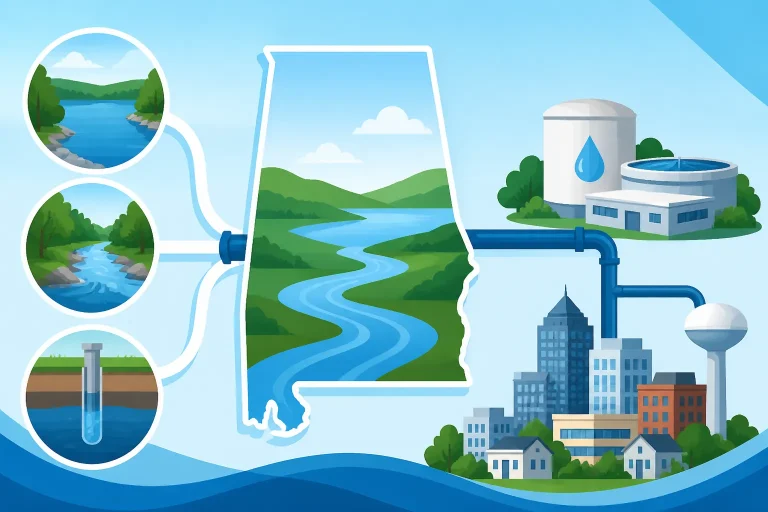
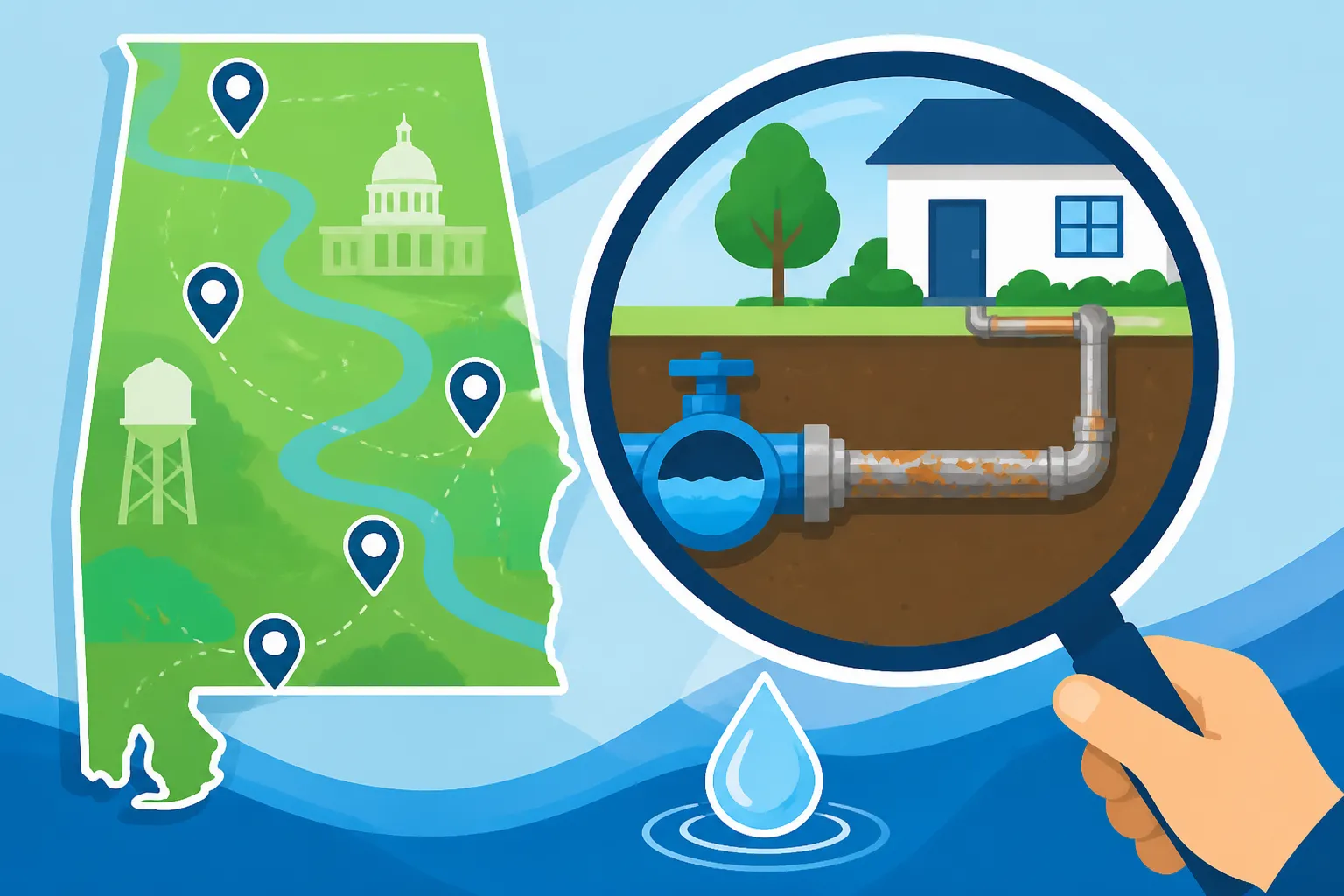
A service line is the pipe that carries water between a public water system’s distribution main and a building. The line may pass through public and privately controlled property, and the division of ownership or maintenance responsibility can vary. Ask the water provider where that division falls for your address rather than assuming that the whole line belongs to the utility or the property owner.
A service-line inventory is a record of pipe materials. According to the Alabama Department of Environmental Management, these inventories are intended to identify the materials that the lines are composed of. That makes them useful for locating known lead lines and identifying records that still need clarification.
An inventory is not the same as a water-quality test at a kitchen tap. It describes pipe material, not the amount of lead that may be present in water from a particular faucet. Water chemistry, plumbing inside the building, fixtures, and the condition of pipes can all matter to what comes out of a tap. For help understanding the distinction, see Could Lead Infiltrate Your Alabama Drinking Water?.
An inventory also is not necessarily a complete description of every pipe inside a property. A provider’s record may address the service line but not interior plumbing, a building’s own piping, or the material of every fixture. A customer looking for a full picture should treat the inventory as one piece of information and ask what parts of the connection it covers.
Why the material matters
Lead can be a concern when water comes into contact with lead-containing plumbing. Identifying pipe material helps a water system and its customers understand where further investigation or action may be needed. The inventory does not, by itself, establish that water at a particular tap has a specific lead level, nor does a record that says “non-lead” describe every component in a home’s plumbing.
The terms used in records can also be easy to misread. A material may be listed as lead, galvanized, another known material, or unknown. These categories tell you what the record identifies—or does not identify—about the line. They do not automatically say whether the utility has inspected the pipe along its entire route.
Why an “unknown” entry deserves follow-up
An unknown classification means the available record does not establish what the line is made of. It should not be read as confirmation that the pipe contains lead, but it also is not proof that it does not. Ask the provider what evidence supports the entry and whether there is a process to update the record when better information becomes available.
For a closer look at inventory notices and uncertain classifications, see Lead, Galvanized, or Unknown? Verifying Utility Inventory Notices. If you are unsure what a line’s status means for your property, Service Line Inventories Across Alabama Public Water Systems offers related context.
How ADEM’s tracking process works
According to the Alabama Department of Environmental Management, community and nontransient, noncommunity public water systems had to submit service-line inventories to ADEM by October 16, 2024. The inventories were to identify the materials the lines are composed of.
That requirement gives ADEM a way to track service-line information submitted by covered public water systems. It also establishes a record for understanding where material is known and where information may remain incomplete. The submission deadline does not mean every line was physically exposed or independently verified by that date. A submitted inventory is a record, and its usefulness depends on the information the system had and the method used to identify it.
The process is not the same as ADEM directly inspecting every home’s plumbing. The public water system is the source of its inventory submission; the property owner’s own pipes and fixtures may not be represented in that record. ADEM’s role in tracking inventories should therefore be distinguished from a homeowner’s need to confirm the material serving a particular building.
What the deadline does and does not tell you
The deadline tells customers when the covered systems had to submit their inventories to ADEM. It does not, on its own, answer whether a particular address was listed as lead, galvanized, another material, or unknown. It also does not tell you whether a utility has since obtained new information about a service line.
If you need an address-specific answer, check the provider’s published inventory or ask the provider directly. If the published record differs from a notice you received, or if it does not show your address, ask the provider to explain which record is current and what area the inventory covers.
Why records can have gaps
Service-line records can be built from information collected at different times and in different ways. A provider may have old construction or repair records, information supplied by customers, visible pipe observations, or other documentation. The evidence available for one property may not be the same as the evidence available for another.
A record can be incomplete because the pipe is not visible, because earlier documentation did not specify material, or because only part of the line was identified. These are general reasons an inventory may contain unknown or partial information; they do not establish how a particular Alabama provider compiled its records. Ask the provider what sources it used for your address and whether the information covers the full service line.
For more on how inventories relate to utility records, see How to Check if Your Alabama Home Has an Unknown Service Line. If you want to understand what questions to put to the provider, Does Your Service Line Contain Lead? Asking Your Utility is also relevant.
How to read a service-line entry
Read an inventory entry as a statement about documented material, not as a guarantee about the water at the tap. The wording matters. Check whether it describes the full service line, one portion of it, or a material category that still needs confirmation. If the record is unclear, ask the provider to explain the entry in writing.
| Inventory wording or situation | What it may tell you | What to confirm with the provider |
|---|---|---|
| Lead | The record identifies lead as a material for the line or a portion of it | Whether the entry covers the full line and what follow-up applies to the address |
| Galvanized | The record identifies galvanized pipe, but that label alone may not clarify the pipe’s history or condition | Whether the record applies to the full line and whether the provider has additional information |
| Unknown | Available records do not establish the material | What information is missing and whether further identification is planned or available |
| Another named material | The record identifies a material other than those above | Whether the entry describes the whole line or only a known segment |
| No address-specific result | The record you checked does not give a clear entry for the property | Whether the address is included under a different account, parcel, or location description |
These labels are a practical way to frame questions, not a substitute for the provider’s definitions. Different records may use different wording, abbreviations, or fields. If the entry is abbreviated or confusing, ask for the meaning of the exact term rather than relying on an assumption.
A material entry is not a tap-water result
A pipe-material record does not report a measured lead concentration from your faucet. Conversely, a water test is a sample from a particular location and time; it does not necessarily identify the material of every pipe between the main and the tap. If you are trying to answer both questions—what the line is made of and what is in the water—you may need to pursue them separately.
The provider can explain what its inventory says about the service line. A qualified laboratory can advise on sampling and testing options if you want a water result. See Testing an Alabama Home’s Tap Water for Lead for more on household testing, and Finding ADEM-Certified Drinking Water Labs in Alabama for information about selecting a lab.
The service line may be only part of the plumbing picture
A service-line inventory generally focuses on the connection between the public system and a building. The plumbing within a building can include different materials, and a service-line record may not cover those pipes, connections, or fixtures. This distinction matters in older buildings, rental properties, and homes where plumbing work has changed over time.
If the provider confirms that the service line is not lead, that information is useful, but it does not establish the material of all interior plumbing. If the provider identifies lead or an unknown segment, that still does not describe every fixture or determine a tap-water test result. For additional background on how pipe materials can affect household water, see How Service-Line Materials Affect Household Water Chemistry.
How to check the record for your address
Start with the water provider that serves the property. If you are not sure which provider serves the address, a water bill, rental paperwork, or property records may help identify it. Avoid assuming that a city name alone identifies the water supplier; service areas and provider names do not always line up neatly with mailing addresses.
Look for a service-line inventory, a service-line material lookup, or customer information about pipe materials on the provider’s official website. Some providers may publish a search tool or downloadable record; others may direct customers to contact them. Do not assume that every system presents its inventory in the same format or that a search result is the last word on a property’s pipe.
If you cannot find an address-specific entry, contact the provider through its official website and ask for the status of the service line. Keep your question specific. You are trying to find out what the record says, what parts of the line it covers, and what evidence supports the classification.
Questions worth asking
When contacting the provider, you can ask:
- Is this address included in the service-line inventory, and what material is listed?
- Does the entry describe the entire line or only a known portion?
- Is any portion classified as unknown?
- What records, observations, or other information support the classification?
- Does the provider have a process for correcting or updating the entry?
- If the line is classified as lead or unknown, what steps does the provider recommend for this property?
- Where can you find the provider’s current written information about service-line materials?
These questions do not require you to know technical terms in advance. If the response uses an unfamiliar label, ask the provider to define it and explain whether the label applies to a particular segment or the full connection.
For help when you rent, see Renting in Alabama? How to Confirm Service-Line Material With Utility. If you own the property and do not know what records to request, Checking Your Home Water Service Line Under ADEM Rules may help you organize the inquiry.
Keep a record of the response
Save the provider’s reply, the date you checked the inventory, and any supporting documents or photographs you receive. If the provider gives a verbal explanation, write down the key points and ask whether the same information is available in writing. A clear record makes it easier to follow up if the inventory changes or if you later need to discuss the property with a landlord, buyer, contractor, or utility representative.
If the address appears under a different spelling, account name, unit, or parcel description, ask the provider how it indexes properties. Multi-unit buildings can require extra clarification: an inventory may identify the connection serving the building without describing every unit’s interior plumbing. Confirm whether the answer applies to the whole building, a particular service connection, or your individual unit.
What to do when the material is unknown or lead is listed
An unknown entry calls for clarification, not guesswork. Ask the provider what information is missing and whether it can explain the next available step for identifying the material. The provider may have more detail than appears in a public lookup, or it may need additional information from the property owner. Do not assume that a line is lead solely because it is unknown, and do not assume that it is safe to disregard the entry because no lead is confirmed.
If the provider identifies lead, ask which portion of the line is involved, whether the record applies to the full connection, and what actions the provider recommends. The utility’s answer matters because it can distinguish the public-side record from the customer-side portion and explain any available process. Do not arrange excavation or pipe replacement based only on an ambiguous online entry. Work on a service line can involve utility coordination, property access, permits, and plumbing requirements that should be confirmed before work begins.
If a provider says its record is incorrect, ask how to submit supporting information and how a correction will be documented. A contractor’s observation, an old invoice, or a property document may help establish what is present, but ask the utility what evidence it can accept. Keep copies of any records, photographs, or work documents that relate to pipe material.
If you are buying or selling a home
A service-line entry can be useful due diligence, but it should not be treated as a complete plumbing inspection. Ask the seller or provider for the current inventory status and any documentation of past line work. If the answer is unknown, make that uncertainty explicit when deciding whether to arrange further evaluation. A home inspection may not expose buried pipe, so ask the inspector what was actually observed and what remains unverified.
For buyers, it is sensible to separate the questions: what the utility’s inventory says, what can be confirmed about the service line, and whether a tap-water sample is warranted. A seller’s assurance or an old service record may help, but it does not automatically replace current confirmation from the provider. Related considerations are covered in Buying a Home With Water Treatment: Why Independent Tests Matter and Finding Your Property’s Septic Permit and Layout Diagram is not relevant here? Must use exact relevant; avoid that. Better use Does Your Service Line Contain Lead? Asking Your Utility already used. We can just include one relevant link perhaps Lead and Copper in Alabama Tap Water: Testing and Rules.
For sellers, make clear which documents show an actual pipe material and which merely describe a past project or estimate. If work changed only part of a line, say so rather than presenting the entire line as verified. The provider can clarify what its inventory currently reflects.
If you rent or live in a multi-unit building
Ask the property owner or manager for the service-line information and identify the water provider serving the building. You can also contact the provider with the building address and ask whether it can explain the inventory entry. A provider may be able to describe the service line to the building, while the owner or manager may have records about interior plumbing and renovations.
In an apartment or other multi-unit property, a building-level service-line record does not necessarily identify the materials inside each unit. If the provider’s answer is vague, ask whether it applies to the connection at the property boundary, the shared building service, or plumbing inside a particular unit. Keep the distinction clear when discussing water testing or plumbing work.
What inventories cannot answer on their own
An inventory is valuable because it organizes material information across public water systems, but it has limits. It may not tell you the condition of a pipe, the exact location of every material transition, or whether a specific faucet’s water contains lead. It may not include a complete history of repairs. And it may not cover plumbing inside a building.
For those reasons, an inventory should guide the next question rather than end the inquiry. A known lead classification raises a different follow-up from an unknown classification, and both differ from a clear record showing another material. In each case, ask what portion is described and what evidence supports the entry.
Inventory status and water testing answer different questions
If you want to know what pipe material is documented, ask the provider about the inventory. If you want to know what a water sample shows, ask a qualified laboratory or appropriate local public health professional about testing. A sample result relates to the sample collected; it does not necessarily tell you the material of an underground line. Likewise, a pipe inventory does not measure the water in your kitchen.
Sampling instructions can affect results, so follow the laboratory’s directions rather than improvising. For more detail on sample collection and interpretation, see Collecting Cold-Water Tap Samples for Household Lead Testing and Interpreting Alabama Drinking Water Lab Reports and Standards. If you have questions about possible health effects, contact your local health department or a medical professional.
Treatment is a separate decision
Do not choose a filter or treatment device based only on a service-line inventory. The inventory does not provide the household’s tap-water result or identify every possible contaminant. If you consider a filter, check that its certification and claimed reduction are appropriate for the contaminant and your own water test results. A treatment product should not be described as a substitute for determining the pipe material or resolving a utility-record question.
If lead is a concern, Choosing the Right Lead Filter for Your Alabama Drinking Water explains why product claims and certification need to match the specific need. For general testing and treatment decisions, Alabama Drinking Water Contaminants and Home Testing Guide can help put the next steps in context.
Keeping track as records change
Service-line records can be updated when a provider receives better documentation or completes work. A result you checked earlier may not reflect later changes, so ask the provider whether it has updated information if the property has undergone plumbing work or if you have received a new notice. The provider can tell you how to confirm the current record and whether it keeps historical information.
If service-line work is planned, ask who is responsible for coordinating it, which portion will be addressed, what permits or approvals may be needed, and how the provider will document the completed work. Do not assume a contractor’s description will automatically update the utility inventory. Ask how the provider wants material information submitted and keep the paperwork after the work is finished.
It can also help to keep service-line information with other home records, such as plumbing invoices, inspection reports, and water test results. Label each document by what it actually establishes. For example, a record that identifies a replacement section is not necessarily proof that every part of the service line was replaced. A water test result is not a pipe-material record. Keeping those distinctions visible makes future conversations more accurate.
If you receive a notice with material information, compare it with the provider’s current record and ask about any mismatch. Do not treat a mailed notice, online entry, contractor note, or water test as interchangeable. Each may answer a different question. For further context on utility notices and lead-line status, see Alabama Lead Pipe Notifications: Deadlines for Water Users.
The practical takeaway is straightforward: ADEM tracks inventories submitted by covered public water systems, while the system’s record is the place to begin for an address-specific question. Check the entry, confirm what portion of the line it describes, and ask the provider to explain any unknown or conflicting information. That approach is more reliable than inferring pipe material from a home’s age, a neighborhood, or a water test alone.
Frequently Asked Questions
Does an ADEM inventory confirm the material of every pipe in my home?
No. The inventory identifies service-line materials submitted by the public water system. It may not describe interior plumbing, fixtures, or every pipe in a building. Ask the provider what portions its entry covers.
Does an unknown service-line entry mean the pipe contains lead?
Not necessarily. Unknown means the available record does not establish the material. Ask the provider what information is missing and whether it has a way to update the classification.
Can a water test tell me whether my service line is lead?
A water test measures the sample collected; it does not necessarily identify the material of the service line. Ask the provider about pipe material and a qualified laboratory about testing.
Who should I contact to check the inventory for my address?
Start with the water provider serving the property. Use its official website to find current contact details and ask whether the address is included, what material is listed, and what part of the line the record covers.
Sources
- Alabama Department of Environmental Management — Information for Consumers | Alabama Department of Environmental Management (checked November 13, 2026)
Disclaimer
This article is for general informational purposes only and does not constitute professional advice. Laws, prices and regulations vary by location and change over time. Consult a qualified professional for guidance on your specific situation. Alabama Water Guide is not a government agency or water utility and is not affiliated with any public water system.